How Far Can You Go? Ultra Trails and Backyard Ultras in Portugal

Some races have you counting down the kilometres to the finish. Others have you counting the climbs still ahead. And then there is a format where you return to the start, rest for a few minutes and do it all again — without knowing when it will end.
For runners looking for a demanding challenge, difficulty comes in different forms. Long distances require hours of carefully managed effort. Elevation changes what every kilometre feels like. A backyard ultra adds uncertainty: the next lap always starts on schedule, but the finish remains undecided.
If you are looking for challenging races in Portugal, these three events offer different ways to test your endurance between November 2026 and March 2027.
Ultra Trail Serra de Grândola: 46K to Manage from Start to Finish
1 November 2026 · Grândola · 46K
Going beyond the marathon distance is already a commitment. Doing it on trails, with steep climbs and descents, adds another layer.
The main distance at Ultra Trail Serra de Grândola covers 46 kilometres with an 8-hour-30-minute time limit, starting and finishing at Complexo Desportivo Municipal José Afonso. The course follows trails and paths through the surrounding hills.
Starting too fast could make the second half considerably harder. Fuelling, hydration and adjusting your effort on the climbs are part of the strategy from the beginning.
This is a challenge to consider if you have already built experience on trails and want to take on a longer race. The event also offers 26K and 13.5K alternatives for runners looking for a different commitment.
What makes it demanding: the combination of distance, uneven terrain and repeated changes in gradient.
Explore Ultra Trail Serra de Grândola on RaceFinder.
Trail Cidade de Faro: 32K with 1,600 Metres of Climbing
1 November 2026 · Estoi, Faro · 32K
If your image of running in the Algarve is a flat route beside the sea, Estoi offers a different perspective.
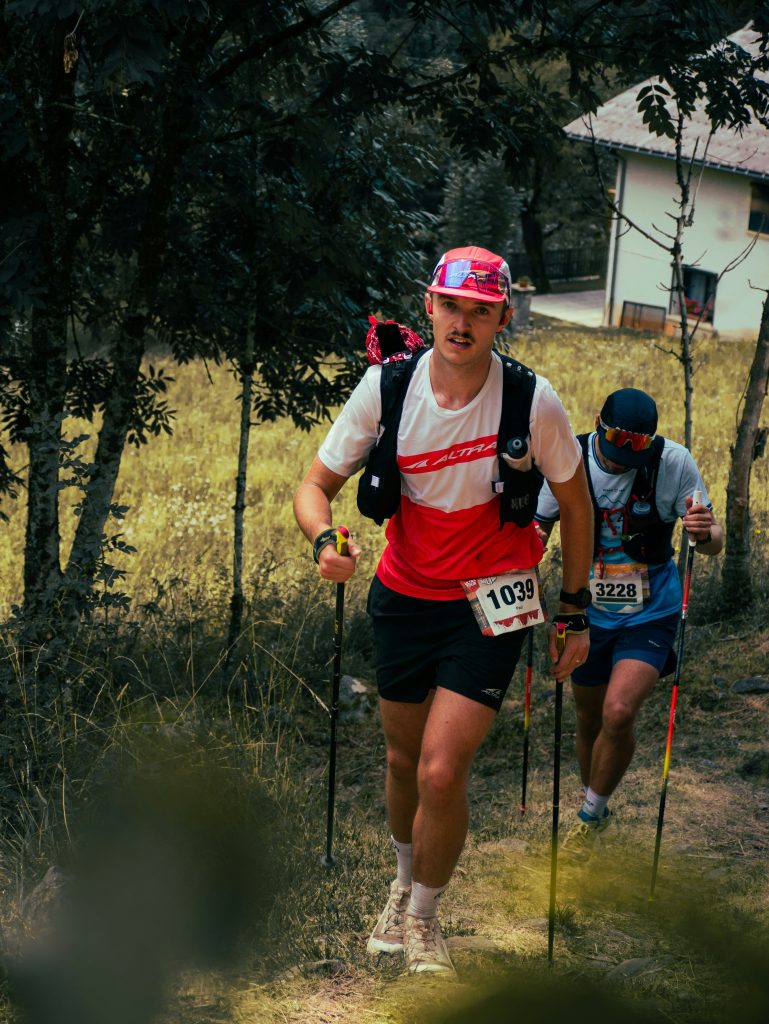
The long course at II Trail Cidade de Faro features 32 kilometres and approximately 1,600 metres of elevation gain. Rural paths, natural trails and forest tracks make up the route, with an announced time limit of 5 hours and 30 minutes.
The distance is shorter than a marathon, but the climbing gives a clearer picture of the challenge. You need enough control and energy left for the descents, as well as the strength to get uphill.
For runners who enjoy a race where the elevation profile matters as much as the distance, this is an option worth exploring. Training on climbs and descents becomes a significant part of preparation.
What makes it demanding: the climbing packed into 32 kilometres and the need to manage your effort within the time limit.
Explore Trail Cidade de Faro and registration options on RaceFinder.
Backyard Ultra Ansião: The Challenge Is Starting Again
20 March 2027 · Ansião · Approximately 6.706K every hour
At first glance, a loop of just over six kilometres with an hour to complete it might sound manageable.
The question is how many times you can repeat it.
The third Backyard Ultra Ansião starts at 9:00 am at Parque Empresarial do Camporês. The advertised course covers approximately 6.706 kilometres with 80 metres of elevation gain per lap, with a new start every hour.
The effort builds in a particular way. Finish a lap, eat, drink, adjust your kit and get ready to return to the start. Your rest time depends on how long you spent out on the course.
Running faster gives you a longer break, but may use energy you will need later. Moving more slowly reduces the intensity, but leaves less time between laps.
What makes it demanding: repetition, managing the breaks and having no predetermined finishing distance.
Explore Backyard Ultra Ansião and register on RaceFinder.
How Does a Backyard Ultra Work?
In the original format, each loop measures 6.7056 kilometres, and a new lap starts exactly one hour after the previous one.
Every runner still competing must be inside the starting corral when the bell rings. Anyone who fails to complete the loop within the hour, or misses the next start, is out.
The race continues until only one runner remains. That runner must complete one final lap alone to win. If nobody manages it, there is no winner. These are the official Backyard Ultra rules.
Here is how the distance adds up:
| Completed laps | Approximate distance |
|---|---|
| 6 | 40.2 km |
| 12 | 80.5 km |
| 24 | 160.9 km |
One lap tells you little about the overall difficulty. After several hours, getting out of your chair and lining up again becomes a central part of the challenge.
Which Kind of Challenge Appeals to You?
All three formats demand endurance, but each asks something different.
In an ultra with a fixed distance, you know where the finish is. Your task is to manage your effort and resources to reach it within the race conditions.
On a trail with substantial elevation gain, you constantly adapt your stride and intensity. Average pace alone tells you very little about how well you are running.
In a backyard ultra, the course becomes increasingly familiar, but you still do not know how many laps remain. Your routine between starts becomes part of the competition.
Choosing well means understanding which demands match your experience and the preparation you are willing to put in.
A Serious Challenge Starts Before Race Day
A demanding race can give several months of training a clear direction. Turn the idea into a practical plan: study the course, try your equipment, test your fuelling and train in conditions that resemble the event.
Good decisions are part of endurance too. Adjusting your pace, revising a target or stopping when necessary all belong in that preparation.
Between the long trails of Grândola, the climbs around Estoi and the repeated laps of Ansião, there are different ways to discover what you can build towards.
Explore races on RaceFinder and find your next endurance challenge.