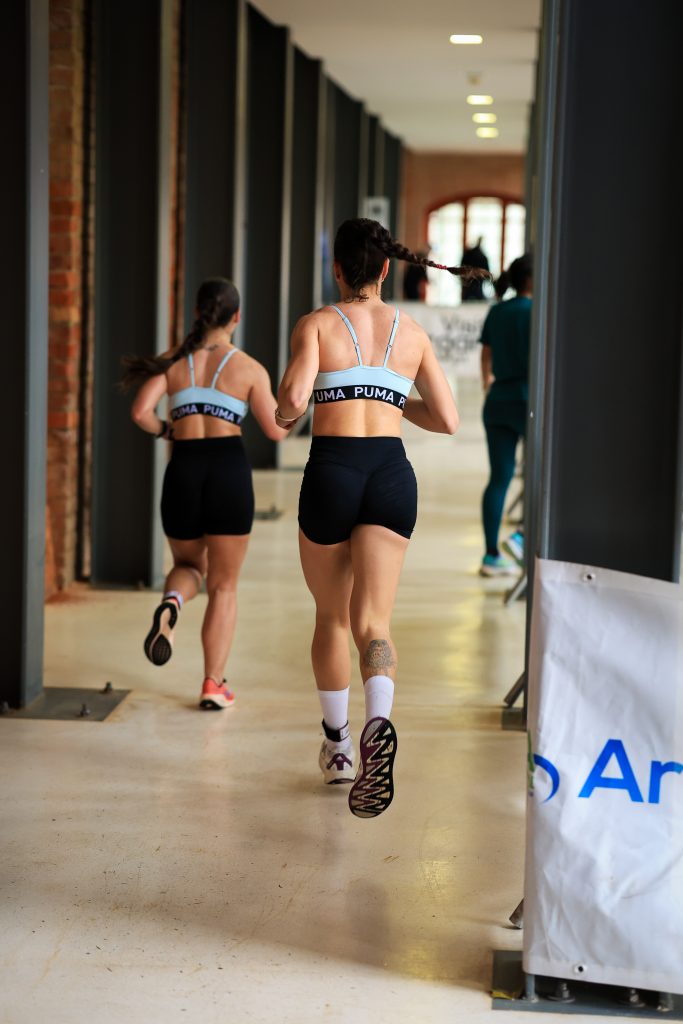
From Training Partners to the Start Line: Why Hybrid Racing Is Making Teamwork Part of the Strategy

There is a big difference between training with someone and racing with someone.
In training, each person can adjust the pace, rest a little longer or decide that the final block is not happening after all.
In a doubles race, that changes.
The running pace becomes a shared decision. The workout stations need to be divided. Strategy stops being individual. And when one person starts to struggle, the other becomes part of the solution.
That is exactly what makes doubles formats so interesting in the growth of hybrid racing in Portugal.
You do not just need someone as strong as you
The first instinct is often to choose the fastest or strongest person in the group.
But the best doubles team is not necessarily made up of the two athletes with the best individual numbers.
Imagine one of you is clearly the stronger runner but struggles more with strength-based movements. The other may be able to take on more work at the stations but needs a more controlled pace between them.
That combination can work much better than pairing two athletes with exactly the same strengths.
The strategy starts before race day:
Who should take more repetitions?
Which stations are worth switching more frequently?
Who sets the running pace?
And what happens if one of you has a worse day than expected?
Doubles racing turns those questions into part of the competition.
HYGOES: run together, split the work
HYGOES 2026, taking place on September 12 in Góis, is raced exclusively in men’s, women’s and mixed doubles.
The format combines eight 1 km running segments with eight functional stations. Both athletes complete the running sections together, while the work at the stations can be divided between the pair.
That is where your choice of partner really starts to matter.
If one athlete is clearly stronger at a particular station, it may make sense for them to take on a larger share of the work. But pushing too hard at one station can easily come back to hurt you in the next kilometre.
It is not just about splitting repetitions.
It is about managing energy as a team.
PRIME Hybrid Espinho: when you also have to choose the level
At PRIME HYBRID ESPINHO FITNESS RACING, taking place on September 26, athletes can compete individually or in doubles, with both Open and Pro divisions available.
The race combines eight 1 km running segments with eight functional stations and includes men’s, women’s and mixed doubles categories.
That creates another important decision.
It is not just “who am I racing with?” but also “which division makes sense for us?”
For a team entering fitness racing for the first time, choosing the right category can make the experience much more enjoyable than immediately stepping into the hardest division.
Your first race does not need to prove that you belong in the toughest category.
It can simply show you how well you work together once the clock starts.
Crossers: eight kilometres feel very different when there are eight stations in between
Crossers – The Hybrid Race, scheduled for October 18 in Loures, also focuses on doubles racing.
The event combines running with eight functional fitness stations and includes men’s, women’s and mixed doubles categories.
It is a good example of why judging a hybrid race only by its running distance can be misleading.
Kilometre six does not start with the same legs as kilometre one.
Between the two, you have already completed functional work, transitions and several decisions about who should do what.
That is where a well-coordinated pair can save a lot of time without necessarily running faster.
Your partner can also be the reason you try it
Not everyone looks at an individual hybrid race and immediately thinks, “I want to do all of that alone.”
For many athletes, doubles are exactly what makes the first race feel possible.
Having someone next to you makes the unknown less intimidating. You can prepare together, test strategies in training and share the workload when race day arrives.
After your first race, you may decide you want to compete solo next time.
Or you may realise that the best part was having someone there to suffer with you.
There is room for bigger teams too
The trend does not stop at doubles.
The Azores Hybrid Race, taking place on October 17 and 18 in Ponta Delgada, includes individual, doubles and relay formats.
That opens hybrid racing to groups with very different goals.
One athlete may want to test themselves individually.
Two athletes may want to build a strategy together.
And a larger group may simply want to turn the event into a team experience.
It is also one of the reasons hybrid racing is bringing gym communities, boxes and training groups closer to the start line.
How should you choose your partner?
Do not choose based on strength alone.
Think about three things first: running pace, strengths at the stations and the ability to communicate when tired.
If both of you want to do every station in exactly the same way, you may be wasting one of the biggest advantages of racing as a pair.
The goal is not necessarily to split everything 50/50.
It is to find the division that allows both of you to arrive stronger at the next part of the race.
And that is something you only discover by training together.
Training together changes the preparation
Before race day, try sessions that alternate running with functional exercises.
Test different work splits.
Find out which movements are better suited to shorter switches and where one athlete can maintain the work for longer.
And most importantly, practise transitions.
A perfect strategy on paper can disappear very quickly when both of you arrive breathless at a station and spend 20 seconds deciding who starts.
The more decisions you make before the race, the fewer decisions you will need to make while exhausted.
In the end, your partner becomes part of the race experience
Some races are completely individual.
In a doubles hybrid race, part of the memory will inevitably be linked to the person who was beside you.
The run you started too fast.
The station where one of you had to take on more work.
The moment when you thought you could no longer hold the pace.
And probably the conversation after the finish line about whose idea it was to sign up in the first place.
Maybe that is what makes the format so interesting.
Your next race may not just need a goal.
It may also need a partner.